

Why Time Coherence Is Audible
Manger Knowledge
Our Hearing Perceives Time
Why does some music reproduction immediately sound natural and realistic, while other systems appear artificial despite impressive technical specifications?
The answer is not found in frequency response alone. Human hearing is highly sensitive to temporal changes within a sound event. Even small deviations in time behavior influence how natural, spatial and believable sound reproduction appears.
“The auditory system first analyzes temporal pressure changes.”
— Josef W. Manger
Hearing Originally Evolved as an Orientation System
Human hearing did not originally evolve for music. It developed as a survival mechanism capable of identifying direction, distance and potential danger within fractions of a second.
A breaking twig, footsteps or the attack of a drum generate extremely short dynamic pressure changes — so-called transients. The auditory system processes these signal components with remarkable precision.
Crucially, the brain first detects the onset and spatial characteristics of a sound event before analyzing pitch and timbre.
Figure 1
How the Human Auditory System Processed Sound
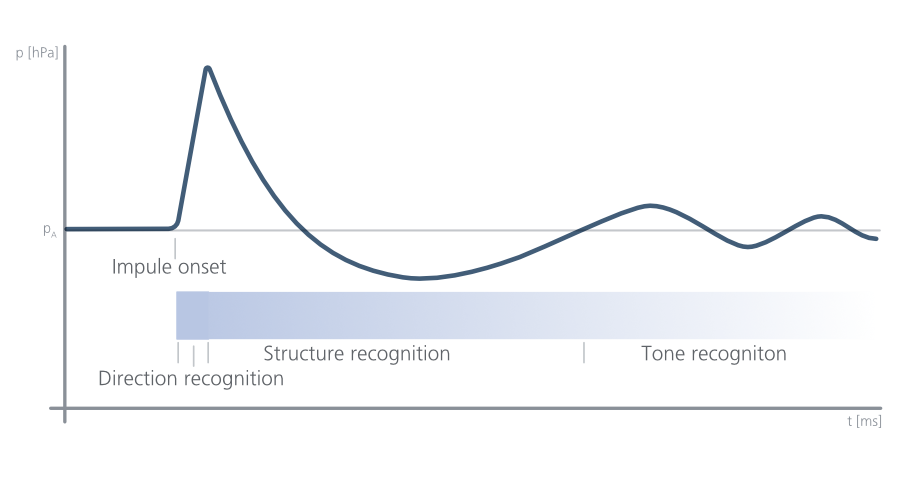
Human hearing does not process sound events through frequency information alone. Temporal pressure changes and their spatial cues are analyzed first, followed by the recognition of structure, timbre and pitch. This temporal processing forms the foundation of localization, spatial perception and natural hearing.
Why Transients Matter
Transients contain essential information about:
- direction
- distance
- size of a sound source
- material characteristics
- spatial structure
The attack of a piano note or the beginning of a human voice consists of highly complex temporal pressure variations.
If these changes are not reproduced accurately, important spatial and structural information is lost. Sound reproduction becomes less natural and less believable.
Why Frequency Response Alone Is Not Enough
For decades, loudspeaker quality was mainly associated with linear frequency response. However, frequency response only describes amplitude distribution over frequency — not temporal accuracy.
Two loudspeakers may measure similarly in frequency response and still sound fundamentally different.
The reason lies in:
- transient behavior
- phase response
- group delay
- resonances
- decay behavior
These characteristics strongly influence how accurately a loudspeaker reproduces short-term pressure changes.
“The error in testing conventional loudspeakers lies not in what is measured, but in what is not measured.”
— Josef W. Manger
The Problem with Conventional Multi-Way Loudspeakers
Many conventional loudspeakers use multiple drivers operating in separate frequency ranges. Each driver introduces its own mechanical behavior, resonances and timing characteristics.
This can lead to:
- delayed signal components
- overshoot
- resonances
- ringing
As a result, the original temporal structure of the signal becomes altered.
This is clearly visible in step response measurements, which reveal how precisely a loudspeaker reacts to sudden signal changes.
Figure 2
Step response comparison
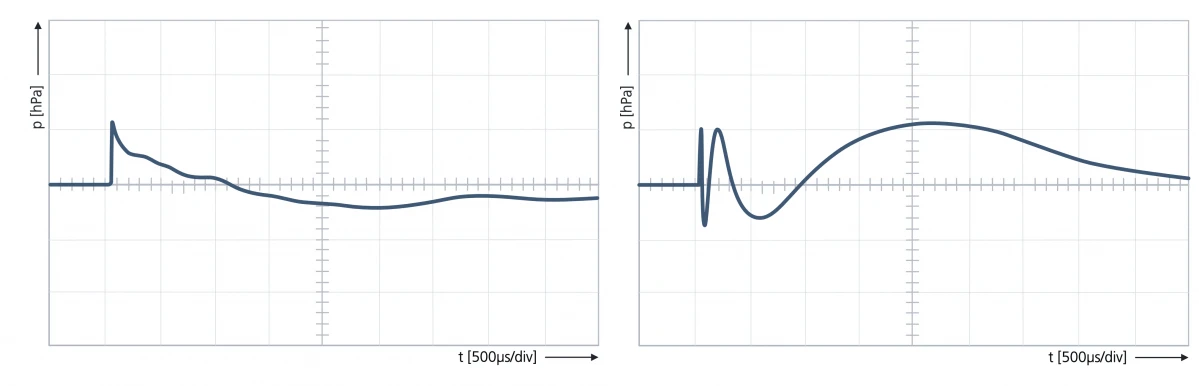
Comparison of the step response of a time-coherent system (left) and a typical multi-way loudspeaker (right). While the input signal is reproduced quickly and in a controlled manner on the left, delayed signal components and ringing effects appear on the right. These influence the reproduction of transients as well as spatial and tonal perception.
While a time-coherent system reacts quickly and decays smoothly, conventional multi-way systems often show complex resonances and delayed energy storage.
The auditory system may not consciously identify these errors — but it reacts to them very sensitively.
Possible consequences include:
- unstable imaging
- listening fatigue
- artificial timbre
- increased listening levels
Figure 3
Wave Propagation Principles in Human Hearing and the Manger Sound Transducer
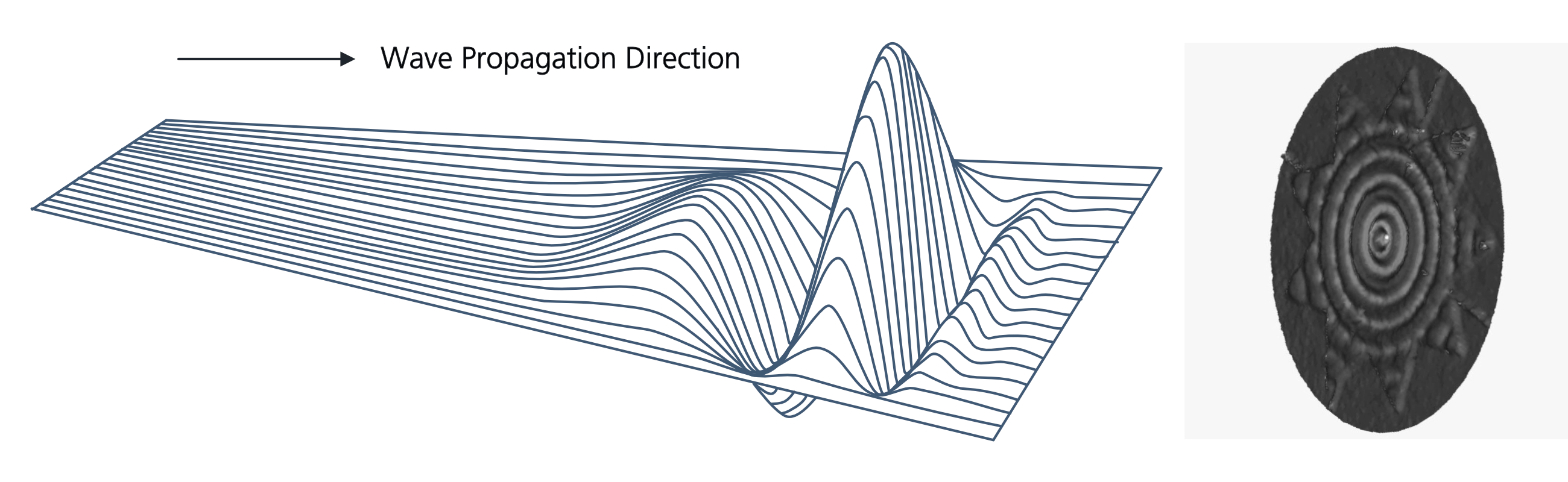
Shared physical principle of wave propagation: On the left, a schematic illustration of the travelling wave along the basilar membrane of the human inner ear; on the right, the vibration pattern of the Manger Sound Transducer measured by laser Doppler vibrometry. Both systems utilize the position-dependent propagation of mechanical waves to process or accurately reproduce acoustic information.
The Manger Sound Transducer Approach
The Manger Sound Transducer was developed specifically for precise time behavior.
Instead of acting as a rigid piston, it operates using controlled bending waves propagating radially across the diaphragm. This principle shows remarkable similarities to the basilar membrane inside the human cochlea.
The effective radiating area changes continuously with frequency:
lower frequencies use larger diaphragm areas, while higher frequencies originate closer to the center.
This results in:
- coherent sound radiation
- precise transient behavior
- controlled decay
- exceptionally homogeneous dispersion
Why Time Coherence Becomes Audible
Time accuracy is not an abstract measurement parameter. It directly affects musical perception.
Audible improvements include:
- more natural spatiality
- more stable imaging
- more believable transients
- reduced listening fatigue
- more realistic timbre
Most importantly, the loudspeaker itself becomes less noticeable.
Attention shifts toward the musical event rather than the reproduction system.
Conclusion
Human hearing is not based on frequency analysis alone. It first analyzes temporal changes within a sound event.
That is why time coherence is audible.
A loudspeaker capable of reproducing transients accurately can convey spatial and tonal information far more naturally and convincingly. Time behavior is therefore not a secondary acoustic parameter, but a fundamental part of realistic music reproduction.
Experience Manger
The best way to get goosebumps is to experience a Manger system. We offer various ways:


Contact us
We love to hear from you, just simply choose the channel of choice to follow or contact us.
Contact us
Manger Audio
Hendunger Strasse 53
97638 Mellrichstadt
Germany
+49 9776 9816
Partners


© Manger Audio · Imprint · Privacy Policy · Contact us · Cookies


